Incubator Placement & Setup: Best Practices for New Labs
Setting up a new laboratory is an exciting milestone, but it also involves critical decisions that directly impact experimental reliability and long-term success. One of the most important early considerations is proper placement and setup for your Memmert incubator.
Memmert incubators are engineered for exceptional temperature uniformity, stability, and reproducibility. However, external factors such as room airflow, heat sources, and vibration can influence recovery times and overall performance. When placement is not optimized, these influences may lead to unnecessary temperature fluctuations, longer equilibration periods after door openings, or increased energy consumption. Thoughtful positioning allows Memmert’s advanced airflow design, precision sensors, and intelligent control systems to function at their best.
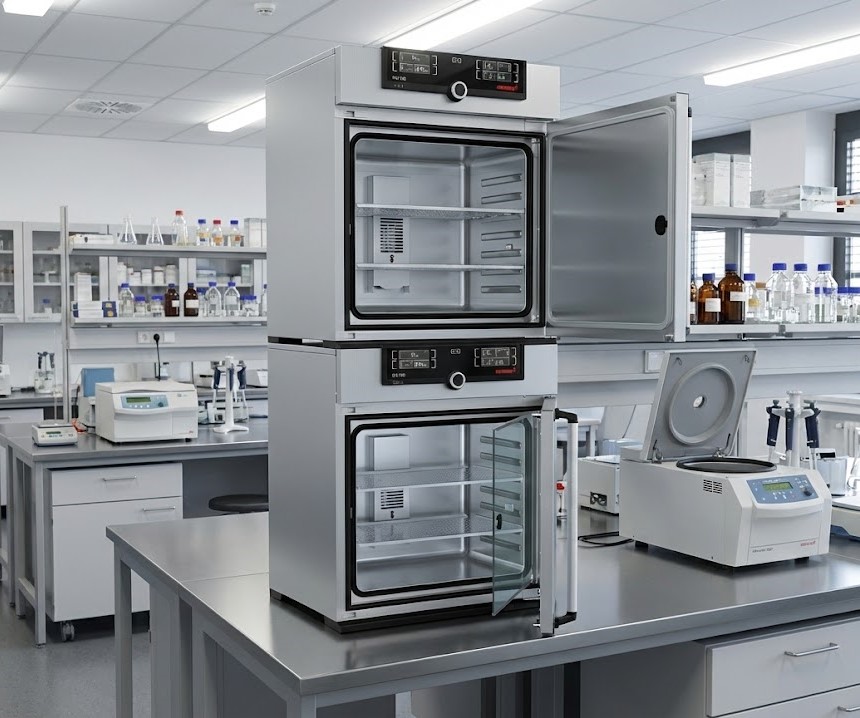
For optimal performance, Memmert incubators should be installed in a temperature-controlled laboratory space with stable ambient conditions and adequate ventilation. Areas with regularly opened doors or wide temperature swings should be avoided. Maintaining proper clearance around the unit is essential to support airflow, heat dissipation, and service access, as outlined in the Memmert operating manual. When stacking two Memmert incubators, approved stacking kits must be used and the installation should be performed on a stable, level surface to ensure safety, accessibility, and consistent performance of both units.
Environmental influences should be carefully managed as well. Direct exposure to sunlight, HVAC vents, ovens, freezers, or other heat- or vibration-generating equipment can interfere with precise temperature control and should be avoided. Incubators should be installed on a flat, load-bearing surface and properly leveled. Correct leveling supports accurate sensor readings, uniform airflow, and long-term mechanical reliability—key factors in maintaining Memmert’s tight temperature tolerances.
Once in operation, loading practices continue to affect incubator performance. Overcrowding the chamber or placing items directly against interior walls can restrict airflow and reduce uniformity. Samples should be spaced to allow proper circulation, and recommended load limits should always be observed. While Memmert’s chamber design promotes consistent airflow, adequate spacing between samples remains essential for achieving reproducible results.
Proper placement and setup are critical to unlocking the full performance potential of Memmert incubators. By establishing the right environmental conditions from the start, new labs can achieve consistent, reproducible incubation while protecting both samples and equipment.
At Memmert USA, we support laboratories at every stage—from equipment selection and installation guidance to long-term performance support. Our incubators are engineered for precision and reliability, but optimal results always begin with proper placement and setup.